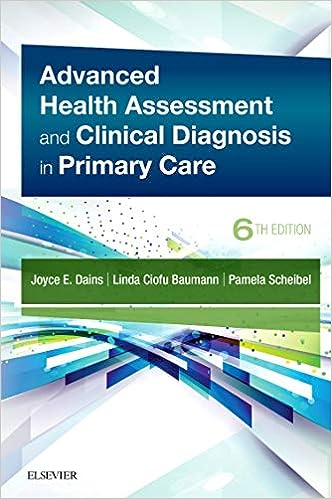
Description
Test Bank For Advanced Health Assessment Clinical Diagnosis in Primary Care 6th Edition Dains
If you’ve been searching for the Test Bank For Advanced Health Assessment Clinical Diagnosis in Primary Care 6th Edition Dains, you’re definitely not the only one. It seems like every semester, nursing and nurse practitioner students end up looking for extra study resources because, honestly, the workload can feel endless. One minute you’re reviewing heart sounds, and the next you’re buried under differential diagnoses and patient case studies. It’s… a lot.
Let’s get this out of the way first. A good study strategy matters far more than simply collecting resources. The real goal isn’t finding shortcuts—it’s understanding the material well enough to apply it in clinical practice. And if you’ve ever stared at a chapter thinking, “How am I supposed to remember all of this?”… yeah, I’ve been there too.
Why Is the Dains 6th Edition So Popular?
Advanced Health Assessment & Clinical Diagnosis in Primary Care, 6th Edition by Dains has become one of the most widely used textbooks in advanced nursing education. There’s a good reason for that.
Instead of focusing only on memorising symptoms, the book teaches you how to think clinically. That’s a huge difference.
Students often appreciate it because it covers:
- Comprehensive health assessment techniques
- Differential diagnosis
- Evidence-based clinical reasoning
- Primary care decision-making
- Patient interview skills
- Common and complex disorders across body systems
It’s challenging. No point pretending otherwise. But that’s exactly why so many nursing programmes continue to use it.
Why Students Search for the Test Bank For Advanced Health Assessment Clinical Diagnosis in Primary Care 6th Edition Dains
You know what’s weird?
Most students don’t start searching for additional study materials until after their first difficult exam.
Then reality hits.
A test bank often comes up in online searches because students want more opportunities to practise answering questions in a format similar to classroom assessments. Practice questions can help identify weak areas and reinforce concepts that may not have clicked during the first read-through.
Students usually hope to:
- Practise critical thinking
- Check their understanding
- Become familiar with question styles
- Improve exam confidence
- Review important clinical concepts
Those goals make sense. The important part is using legitimate practice materials ethically and in line with your course requirements.
Is Using Practice Questions Actually Helpful?
Personally, I think they can be—when they’re used the right way.
Reading a textbook is one thing.
Answering clinical questions without looking at your notes? That’s a completely different challenge.
Practice questions force your brain to retrieve information rather than simply recognise it. That process tends to strengthen long-term retention.
Think about it like this.
Reading about heart murmurs feels productive.
Actually identifying the correct diagnosis from a patient scenario? That’s where the learning really happens.
Best Ways to Study Advanced Health Assessment
Everyone studies differently, but a few strategies seem to work for most nursing students.
1. Read With a Purpose
Don’t just highlight entire pages.
Instead, ask yourself:
- What’s the patient’s main complaint?
- Which findings are abnormal?
- What diagnoses should be considered?
- Which assessment comes next?
Those questions keep your brain engaged instead of drifting into autopilot.
2. Focus on Clinical Reasoning
This textbook isn’t simply asking you to memorise diseases.
It expects you to think like a healthcare provider.
Every symptom should lead to another question.
Every finding should narrow your differential diagnosis.
That’s where real learning starts.
3. Review Case Studies
Case studies connect isolated facts into complete patient scenarios.
They’re also much closer to what you’ll encounter during clinical placements.
Honestly, this was one of the biggest improvements in my own studying. Reading facts is fine. Solving cases? Much more memorable.
4. Space Out Your Study Sessions
Cramming the night before feels productive…
Until the exam starts.
Short review sessions spread across several weeks usually beat marathon study sessions every single time.
Not even kidding.
Common Topics Covered in the Dains 6th Edition
Depending on your course, you may encounter questions involving:
- Cardiovascular assessment
- Respiratory disorders
- Neurological examinations
- Gastrointestinal conditions
- Musculoskeletal assessment
- Women’s health
- Men’s health
- Paediatric assessment
- Dermatology
- Endocrine disorders
- Mental health screening
- Infectious diseases
That’s a long list.
Which explains why so many students feel overwhelmed at first.
The trick isn’t mastering everything overnight.
It’s making steady progress.
Mistakes Students Often Make
This one? Totally avoidable, in my opinion.
Many students spend nearly all their time reading.
Very little time practising.
Unfortunately, exams don’t usually ask you to repeat textbook paragraphs.
They ask you to analyse patient presentations, compare possible diagnoses and decide on the most appropriate next step.
Some common mistakes include:
- Memorising instead of understanding
- Ignoring differential diagnoses
- Skipping review questions
- Waiting until exam week to revise
- Studying alone when a discussion group could help
None of these make someone a bad student.
They’re just easy traps to fall into.
Ethical Ways to Prepare for Nursing Exams
The real question isn’t how many resources you can collect.
It’s whether you’re actually learning from them.
Strong preparation often includes:
- Reading assigned chapters
- Reviewing lecture notes
- Completing instructor-provided practice questions
- Working through patient cases
- Joining study groups
- Using legitimate review resources recommended by your programme
That combination tends to build both knowledge and confidence.
And confidence matters more than people realise.
Tips for Getting More Out of Every Study Session
Sometimes studying smarter really is better than studying longer.
A few ideas:
Create Mini Clinical Scenarios
Instead of reading about hypertension, imagine you’re assessing a patient with elevated blood pressure, headaches and dizziness.
What would you ask?
What would you examine?
What conditions would you consider?
That simple shift makes information stick.
Teach Someone Else
It sounds cliché.
But explaining a topic out loud quickly shows whether you truly understand it.
If you can’t explain it simply…
You probably need another review.
Keep a Differential Diagnosis Notebook
Write down:
- Presenting symptom
- Possible diagnoses
- Key distinguishing findings
- Recommended assessments
Over time you’ll build an incredibly useful revision guide.
Is the Dains Textbook Difficult?
Short answer?
Yes.
But difficult doesn’t mean impossible.
It simply asks students to move beyond memorisation into clinical decision-making.
That transition takes time.
Some chapters will click immediately.
Others might require two or three reads before everything starts connecting.
That’s normal.
Seriously.
Frequently Asked Questions
Where can I find practice questions for Advanced Health Assessment Clinical Diagnosis in Primary Care 6th Edition Dains?
The safest option is to use legitimate practice materials provided by your instructor, publisher-approved study resources, or review books recommended by your nursing programme.
Is the Dains 6th Edition difficult for nurse practitioner students?
Many students consider it challenging because it emphasises clinical reasoning and differential diagnosis rather than simple memorisation.
What’s the best way to study Advanced Health Assessment?
Combine textbook reading with case studies, instructor-approved practice questions, spaced repetition, and regular review of clinical scenarios.
Do practice questions improve exam performance?
They can be very helpful when used to reinforce learning, identify knowledge gaps, and practise applying concepts rather than memorising answers.
Why is clinical reasoning so important in advanced health assessment?
Clinical reasoning helps healthcare professionals evaluate patient information, consider possible diagnoses, and make informed decisions about assessment and care. It’s a core skill for safe and effective practice.
Reviews
There are no reviews yet.