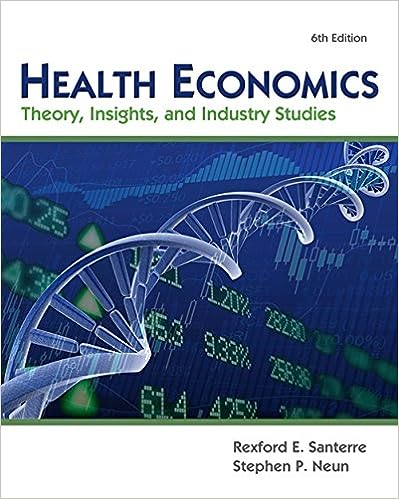
Description
Health Economics Theory Insights And Industry Studies 6th Edition By Dr. Rexford E. – Test Bank
Health economics can feel surprisingly complicated. You’re not just learning about healthcare; you’re also dealing with costs, incentives, resource allocation, insurance, policy decisions, and the uncomfortable question of how limited resources should be used. That’s a lot to take in at once.
Honestly, I’ve been there. You read a chapter, understand it perfectly, close the book, and five minutes later you’re wondering what half of those economic terms actually meant.
That’s one reason students look for the Health Economics Theory Insights And Industry Studies 6th Edition By Dr. Rexford E. – Test Bank. Having practice questions can make studying more active and help reveal the topics that still need some work.
Why Health Economics Can Be Difficult to Study
Let’s get this out of the way: health economics isn’t simply about memorizing definitions.
You’re often expected to understand how economic principles apply to real healthcare situations. That means thinking about why prices change, how healthcare markets behave, and how decisions affect patients, providers, insurers, and governments.
Some common areas include:
- Healthcare demand and supply
- Health insurance
- Healthcare costs
- Resource allocation
- Economic evaluation
- Healthcare markets
- Government policy
- Provider incentives
- Cost-effectiveness
And then there are all those terms that seem straightforward until an exam question words them differently.
You know what’s weird?
A concept can make complete sense while you’re reading it and suddenly feel completely different in a multiple-choice question.
How a Health Economics 6th Edition Test Bank Can Help
Practice questions give you an opportunity to test what you actually remember.
Instead of rereading the same pages over and over, you’re forced to retrieve information. That little bit of pressure can expose gaps you didn’t realize were there.
For example, you may think you understand healthcare resource allocation until you have to apply the idea to a specific scenario.
That’s where practice becomes useful.
Test Your Understanding After Each Chapter
I’d avoid waiting until the night before an exam.
Study one chapter or major topic, then work through related questions while the information is still fresh.
If you get several questions wrong, don’t panic.
It simply tells you where to look again.
Pay Attention to Your Mistakes
This is probably the most useful part.
Don’t just mark an answer wrong and move on.
Ask yourself:
- Did I misunderstand the concept?
- Did I confuse two economic terms?
- Did I overlook something in the question?
- Was I relying on memorization instead of understanding?
- Do I need to review an example from the textbook?
Those mistakes are basically free study guides.
Health Economics Theory Insights And Industry Studies 6th Edition Study Strategy
Personally, I think shorter study sessions work better than trying to absorb an entire textbook in one sitting.
Try this approach:
- Read the assigned material.
- Make brief notes on important concepts.
- Review key terminology.
- Attempt practice questions without your notes.
- Check the answers afterward.
- Write down the topics you missed.
- Revisit those topics later.
Nothing complicated.
The important thing is consistency.
Even 30 focused minutes can be more useful than two hours of staring at pages while your brain has already left the building.
Understanding Health Economics Instead of Memorizing Answers
Here’s the big thing.
A test bank should be a study aid, not something you depend on for memorizing exact answers.
If you memorize a question and its answer word-for-word, you might feel prepared. Then your instructor changes the wording slightly and suddenly you’re thinking, “Wait… wasn’t this supposed to be the answer?”
Not fun.
Understanding the reasoning behind the answer is much more valuable.
If you understand why an economic principle applies to a particular healthcare situation, you’re more likely to recognize the same concept when it appears in a completely different question.
Important Topics to Review for Health Economics Exams
Depending on your course requirements, it can help to spend extra time reviewing major themes rather than giving every topic exactly the same amount of attention.
Consider focusing on:
Healthcare Costs and Resource Allocation
Healthcare resources are limited, while demand for healthcare services can be enormous.
Understanding how resources are allocated—and what economic trade-offs are involved—is a major part of health economics.
Health Insurance and Risk
Insurance changes how patients and providers interact with healthcare costs.
Make sure you understand the economic ideas behind risk, insurance coverage, incentives, and healthcare utilization.
Economic Evaluation in Healthcare
Cost-related analysis can become confusing when several approaches sound similar.
Review the differences between common economic evaluation methods and, more importantly, understand when each approach is appropriate.
Healthcare Markets and Incentives
Healthcare markets aren’t always as simple as ordinary consumer markets.
Patients, physicians, hospitals, insurers, pharmaceutical companies, and policymakers can all have different incentives.
That’s where things get interesting.
Is the 6th Edition Health Economics Test Bank Worth Using?
If you’re studying from the corresponding 6th edition textbook, practice questions can be a useful addition to your normal study routine.
The real benefit isn’t having a huge pile of questions.
It’s using those questions to figure out what you know, what you don’t know, and what you thought you knew.
That last category is sneaky.
Personally, I’d rather discover a weak topic during practice than discover it halfway through an exam.
Reviews
There are no reviews yet.