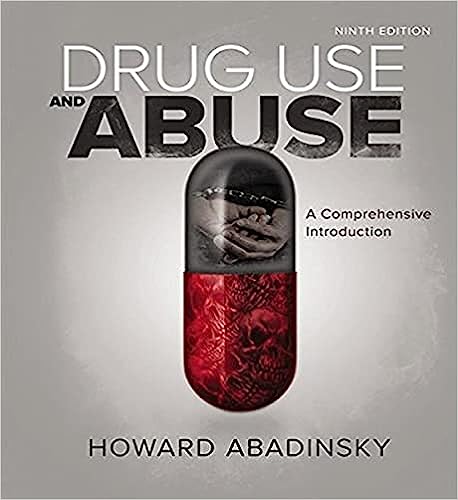
Description
Test Bank For Drug Use and Abuse: A Comprehensive Introduction, 9th Edition, Howard Abadinsky
Drug use and abuse is one of those subjects that can look straightforward until you actually start studying it. Then suddenly there are substances, behavioral patterns, social factors, laws, treatment approaches, risk factors, and a whole lot of terminology to keep straight.
If you’re using Drug Use and Abuse: A Comprehensive Introduction, 9th Edition by Howard Abadinsky, you’ve probably already noticed that simply reading the chapters isn’t always enough to feel ready for an exam. You read everything. You underline things. Maybe you even make flashcards. And then the test comes around and… blank.
Honestly, I’ve been there.
That’s why a Test Bank for Drug Use and Abuse: A Comprehensive Introduction, 9th Edition, by Howard Abadinsky can be useful as a study companion. Practice questions give you a chance to test what you actually remember instead of relying on that familiar feeling of “I’ve seen this before.”
Why Students Use a Drug Use and Abuse 9th Edition Test Bank
Let’s get this out of the way: studying a subject like drug use and abuse isn’t just about memorizing a list of substances.
The topic connects biology, psychology, sociology, criminal justice, public policy, and human behavior. One chapter may focus on a particular concept while another asks you to think about addiction from a completely different perspective.
That can get messy.
A Drug Use and Abuse 9th Edition test bank gives students an organized way to review material through questions and self-assessment.
Instead of spending an entire evening rereading a chapter, you can answer questions and quickly discover which areas you actually understand.
And which ones you don’t.
That second part is important.
What Is the Test Bank for Drug Use and Abuse by Howard Abadinsky?
A test bank is generally a collection of questions designed around the topics and learning material covered in a particular textbook.
For students studying Howard Abadinsky’s Drug Use and Abuse: A Comprehensive Introduction, 9th Edition, practice questions can be used to review major concepts and prepare for quizzes, exams, and other course assessments.
The useful part isn’t simply getting an answer right.
It’s seeing whether you can remember and apply the concept without having the textbook sitting open beside you.
That’s a much better test of preparation.
Major Topics You May Encounter While Studying
A course based on Drug Use and Abuse: A Comprehensive Introduction can cover a broad range of subjects.
Depending on your course and assigned chapters, your study material may include topics such as:
- Drug use and its social context
- Patterns of substance use
- Drug dependence and addiction
- Pharmacological effects of drugs
- Alcohol use and abuse
- Tobacco and nicotine
- Cannabis
- Stimulants
- Depressants
- Opioids
- Hallucinogens
- Prescription and illicit drugs
- Drug-related crime
- Prevention strategies
- Treatment and rehabilitation
- Public policy and drug laws
- Social and behavioral consequences of substance abuse
That’s a lot to keep in your head.
No wonder students sometimes feel overwhelmed before an exam.
Why Practice Questions Can Make Studying Easier
You know what’s weird?
Sometimes you can read a chapter three times and still not know whether you actually learned anything.
Everything looks familiar. The definitions look familiar. The headings look familiar.
Then someone asks you a question without showing you the page, and suddenly your brain decides to take a vacation.
Practice questions help expose that gap.
When you answer a question without looking at your notes, you’re actively retrieving information. If you get it wrong, you’ve found something worth reviewing.
That’s useful.
Test Yourself Before You Feel Ready
You don’t have to wait until the night before the exam to start practicing.
Try a small set of questions after each chapter.
If you do well, great.
If you don’t, even better—you’ve discovered the problem early enough to do something about it.
Personally, I’d much rather find out that I’m confused about a topic while studying at home than during an exam when there’s a clock running.
How to Study With the Abadinsky 9th Edition Test Bank
There’s a right way and a not-so-great way to use practice questions.
The not-so-great way?
Memorize the answer choices.
Please don’t.
If you remember that a particular question had “B” as the answer, that doesn’t necessarily mean you understand the material. Your instructor can ask the same concept using completely different wording.
Instead, use the questions as a learning tool.
Start With Your Textbook
Read the assigned chapter and review your class notes first.
Pay attention to definitions, examples, major concepts, and anything your instructor emphasizes repeatedly.
Those details tend to matter.
Answer Questions Without Your Notes
Close the textbook.
Put your notes away.
Answer the questions from memory.
It might feel harder, but that’s actually the point.
Review Every Mistake
Don’t just check whether you got the question right.
If you got it wrong, ask why.
Was the terminology confusing?
Did you mix up two concepts?
Did you misunderstand the question?
Or did you simply forget something?
Each type of mistake requires a slightly different fix.
Understanding Drug Use and Abuse as a Behavioral Topic
One thing that makes this subject interesting is that drug use isn’t just about the substance itself.
Human behavior matters.
Social environment matters.
Family circumstances, peer influence, psychological factors, availability, cultural attitudes, and other conditions can all influence patterns of substance use.
That’s why studying this subject requires more than memorizing drug names and effects.
You need to understand relationships between different factors.
For example, knowing a definition is useful. Being able to recognize how that concept might appear in a real-world situation is even better.
That’s where practice questions can become particularly helpful.
Preparing for Questions About Addiction and Dependence
Terms related to addiction, dependence, tolerance, and substance use can sometimes become confusing because they sound similar.
Don’t rush through them.
Make sure you understand what each term means within the context of your course.
One useful trick is to write a definition in your own words.
Not the textbook’s wording.
Yours.
If you can explain the concept simply, you probably understand it. If you keep copying the textbook definition because you can’t explain it yourself, that’s a sign you should spend a little more time with the topic.
Reviewing Alcohol and Other Commonly Studied Substances
Many drug-related courses spend significant time examining commonly used substances and their effects.
When reviewing individual substances, don’t only memorize names.
Create a mental framework.
You might review:
- General classification
- Typical effects
- Potential risks
- Patterns of use
- Dependence and misuse
- Social consequences
- Treatment considerations
- Relevant legal or policy issues
This makes the information easier to organize.
Otherwise, everything starts turning into one giant list of facts.
And nobody wants that.
Common Mistakes Students Make While Studying
Trying to Memorize Everything
You probably don’t need to memorize every sentence in the textbook.
Focus on the important concepts and understand how they connect.
Ignoring Course Notes
Your professor may emphasize certain ideas that aren’t obvious from simply reading the textbook.
Keep your class notes nearby.
Studying Only Before the Exam
Cramming might get you through some material, but it’s not a great strategy for a subject with lots of connected concepts.
Even short study sessions spread across several days can be more manageable.
Looking at Answers Too Quickly
This one is huge.
If you check the answer after ten seconds, you haven’t really tested yourself.
Give yourself time to think.
Even if you’re unsure.
Can the Test Bank Help With Exam Confidence?
It can help, especially if you use it consistently.
Something is reassuring about sitting down before an exam and realizing you’ve already worked through questions on similar concepts.
You’re not walking into the exam completely cold.
Of course, practice questions can’t guarantee what your instructor will ask. Every course is different, and instructors often create their own assessments.
But practicing the underlying concepts can make you more comfortable with the material.
And confidence matters.
Not fake confidence. The real kind that comes from actually putting in the work.
How to Get More Value From Your Study Sessions
Try not to measure your progress only by how many questions you answered.
Measure it by what you learned from them.
For example, if you answered 50 questions and missed 15, don’t automatically think, “I did badly.”
Look closer.
Maybe 10 of those mistakes came from one chapter.
That’s actually useful information.
Now you know exactly where to focus.
Keep a short list of your recurring problem areas and review that list before your next study session.
Over time, it should get smaller.
That’s the goal.
Reviews
There are no reviews yet.