Description
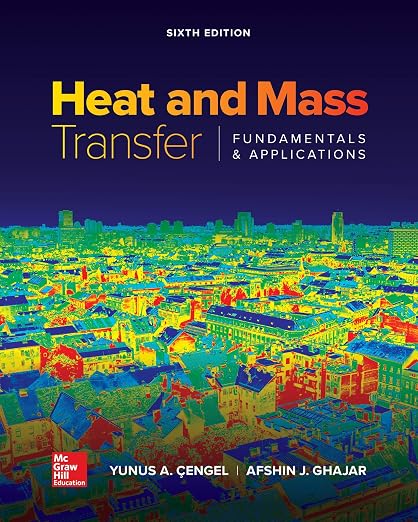
Test bank for Heat and Mass Transfer Fundamentals and Applications 6Th edition Yunus Cengel
If you’re studying heat and mass transfer, you already know how quickly things can get confusing. One minute you’re fine with conduction, and the next you’re staring at a page full of equations wondering where that mysterious number came from. Honestly, I’ve been there.
That’s why students often search for a Test bank for Heat and Mass Transfer Fundamentals and Applications 6Th edition Yunus Cengel. A good test bank can give you a clearer idea of the types of questions you may encounter and help you practice applying concepts instead of simply reading them.
And with exams getting more application-focused, practicing questions is becoming just as important as reading the textbook.
Why Use a Heat and Mass Transfer 6th Edition Test Bank?
Reading a chapter is one thing. Actually solving questions is another.
The Heat and Mass Transfer: Fundamentals and Applications 6th edition by Yunus A. Çengel and Afshin J. Ghajar covers a lot of material. You’ll run into conduction, convection, radiation, heat exchangers, mass transfer, and plenty of calculations.
A test bank can help you:
- Review important chapter concepts
- Practice calculation-based questions
- Find topics you haven’t fully understood
- Prepare for quizzes and exams
- Test yourself without constantly checking your notes
The real benefit? You quickly discover what you don’t know. That’s usually where the useful studying starts.
Heat and Mass Transfer Fundamentals and Applications 6th Edition Questions
One thing I like about practice questions is that they force you to slow down.
You can read a formula ten times and think, “Yeah, I understand this.” Then a question changes one small detail and suddenly… nope.
That’s normal.
Practice questions for the 6th edition can help you work through concepts such as:
Conduction Heat Transfer Questions
These questions commonly involve temperature distributions, thermal resistance, steady-state conduction, and related calculations.
Getting comfortable with the setup is important because the hardest part isn’t always the math. Sometimes it’s figuring out which equation actually applies.
Convection Heat Transfer Practice
Convection problems can involve fluid flow, temperature differences, convection coefficients, and dimensionless numbers.
Working through several variations of these problems makes the process feel much less intimidating.
Radiation Heat Transfer Questions
Radiation can be another headache, especially when multiple surfaces or properties are involved.
Practice helps you become familiar with concepts such as emissivity, blackbody radiation, and radiation exchange.
Heat Exchanger Test Questions
Heat exchangers are another major area where students benefit from repetition.
Questions may involve energy balances, effectiveness, temperature differences, and different heat exchanger arrangements.
Once you’ve solved enough variations, the setup starts becoming much more natural.
How to Study With a Yunus Cengel Heat and Mass Transfer Test Bank
Don’t just grab a question and immediately look at the answer.
Seriously.
Try this instead:
- Read the question carefully.
- Write down the known values.
- Identify what you need to find.
- Sketch the situation if possible.
- Choose the relevant principle or equation.
- Solve it without checking the answer.
- Compare your result afterward.
- Go back and figure out exactly where you went wrong.
That last step matters a lot.
If your answer is wrong, don’t just memorize the correct number. Find the mistake. Was the wrong equation used? Did you mix units? Did you miss a temperature difference?
Those little mistakes are exactly what practice is supposed to expose.
Is the 6th Edition Test Bank Useful for Exam Preparation?
It can be, especially when you use it alongside the textbook rather than treating it as a replacement.
A simple study routine can work surprisingly well:
Read → Review → Practice → Check → Repeat
Start with the chapter you’re currently studying. Complete a few questions without looking at the solutions, then review your weak areas.
If you’re consistently missing the same type of problem, that’s your signal to revisit the textbook section before moving on.
Tips for Solving Heat and Mass Transfer Problems
You know what’s weird about these subjects? Sometimes the arithmetic is easy, but the setup is brutal.
A few habits can make things easier:
- Keep your units consistent.
- Draw simple diagrams when appropriate.
- Write down assumptions before calculating.
- Don’t skip the given information.
- Check whether your final answer makes physical sense.
- Practice both conceptual and numerical questions.
- Review mistakes instead of simply marking answers wrong.
And don’t underestimate dimensional analysis. It can catch some surprisingly silly mistakes.
Where Can Students Find Practice Questions for Heat and Mass Transfer?
Students usually look for practice materials through their textbook resources, university learning platforms, study groups, libraries, and legitimate educational-resource providers.
If you’re searching online, make sure the material clearly matches Heat and Mass Transfer: Fundamentals and Applications, 6th Edition and the authors Yunus A. Çengel and Afshin J. Ghajar.
Edition matters. A lot.
Questions, numbering, terminology, and chapter organization can vary between editions, so using material from a different edition without checking it can create unnecessary confusion.
Final Thoughts
So here’s the bottom line: studying heat and mass transfer is much easier when you actually practice solving problems instead of just reading pages of theory.
A Test bank for Heat and Mass Transfer Fundamentals and Applications 6th edition Yunus Cengel can be useful as a practice resource, particularly when you use it to identify weak areas and improve your problem-solving skills.
Don’t try to memorize every answer. Learn why the answer works.
Once the concepts start clicking, those intimidating equations become a lot less scary. Well… most of them.
Reviews
There are no reviews yet.